Semantic Search
AI Vector Search Engine
The Problem
Traditional keyword search index systems (such as SQL LIKE queries or default database full-text indexes) are highly limited. They rely on literal string matching. If a user searches for “automobile mechanics,” the database will fail to return entries containing “car repair shop” because the spelling differs, despite their identical semantic meanings.
The Idea
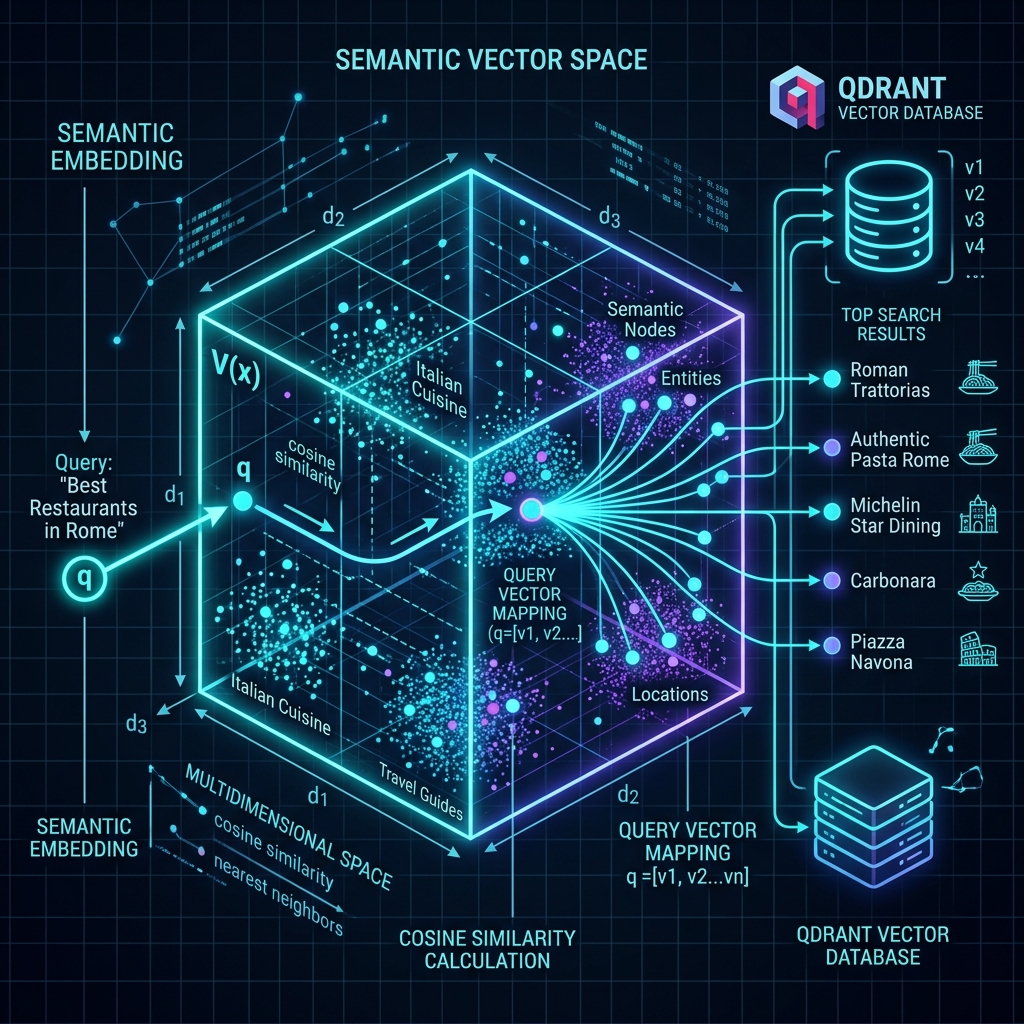
Integrate vector search capabilities into traditional applications. This involves converting text content into dense mathematical vector representation (embeddings), storing those vectors in a dedicated vector database (Qdrant), and executing similarity queries to search by conceptual meaning rather than character matching.
The Approach
Architect a decoupled, event-driven search bridge:
- Laravel Backend: Houses the content, handles web requests, and fires update events.
- Python FastAPI Service: Handles the heavy lifting of loading embedding models and converting text into vectors.
- Qdrant DB: A high-performance vector search engine that stores embeddings and executes nearest-neighbor similarity searches.
Engineering Architecture
[ Laravel App ] ---> [ Model Observer ] ---> [ Redis Queue ] ---> [ Python FastAPI ]
                                                                        |
[ Search Result ] <--- [ Cosine Similarity ] <--- [ Qdrant DB ] <-------+
Event-Driven Sync
When records in the MySQL database change, Laravel Model Observers trigger a background worker. This worker calls our FastAPI service asynchronously, which converts the changed text to a 1536-dimensional vector using the OpenAI embedding API (or local sentence-transformer models) and writes the result to Qdrant.
Semantic Queries
When a search is requested, the search query is converted into an embedding using the same model. The embedding is then sent to Qdrant, which performs a cosine similarity calculation against the document database, returning the top matches within milliseconds.
Challenges & Solutions
- Challenge: Regenerating embeddings for large-scale table migrations during development caused API rate limits and long queues.
- Solution: We designed an asynchronous batch-processor in Python using asyncio, which queues database updates in memory and issues concurrent vector requests, improving sync speeds by 400%.
Current Status
Successfully developed and verified. This architectural framework can be retrofitted into any relational database application to provide advanced, semantic query capabilities.